Why command terms matter
Figuring out what a VCE exam question actually wants can feel like learning a secret language. You stare at a prompt that tells you to analyse or evaluate or justify, and your mind goes blank. Do you write a paragraph or an essay? Do you show your working out? Understanding VCE command terms changes everything. When you know what these words mean, you stop guessing and start answering with total confidence.
Let us break down how these vital instructions work across different subjects and how you can master them without losing your focus during high pressure exams.
Why Command Terms Trip Everyone Up
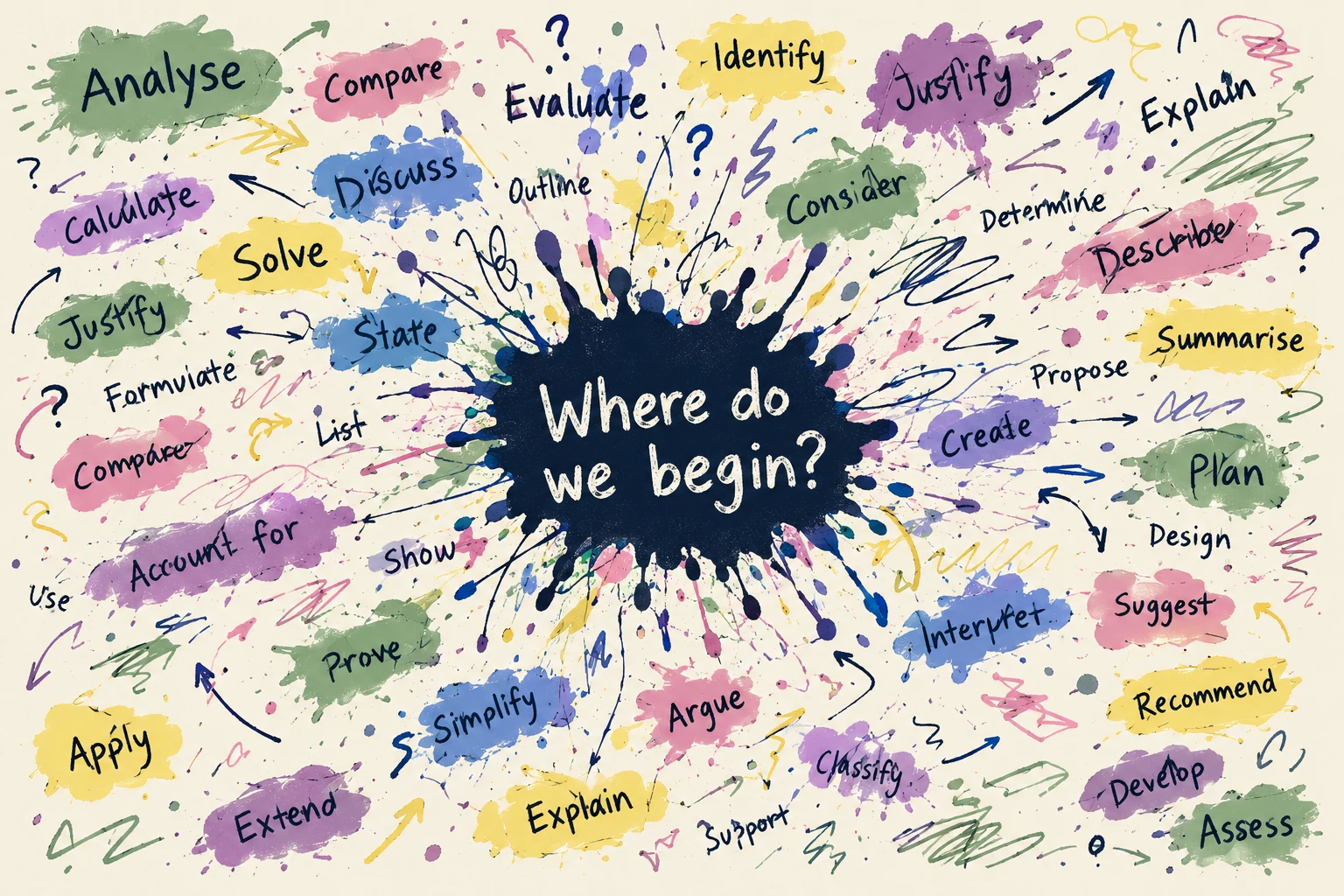
Every single VCE study design relies on specific action verbs. Exam boards use them to set clear boundaries for your answers. If a question tells you to outline a concept, writing a full page wastes precious time. If it asks you to evaluate, giving a simple definition leaves most of the marks on the table.
You need to match the depth of your response directly to the weight of the command word. Misinterpreting a single verb can cost you top marks even if you know the content inside out.
Decoding Subject Specific Nuances
Words change their meaning depending on the classroom you sit in. An evaluation in a history exam looks entirely different from an evaluation in a specialist mathematics paper. Context matters immensely when you face these prompts.
Mathematics Command Terms
Maths assessments test precision, logic, and rigorous working steps.
show that
requires you to work through a logical sequence of steps to reach a given result. You must never skip steps because the final answer is already provided in the prompt. Your job is to prove the path to get there.
The key with a show that question is to assume you did not know the answer.
verify that
means you need to confirm the truth or correctness of a mathematical statement, usually by substituting values or checking boundary conditions.
calculate
asks for a numerical solution where you show all relevant stages in your working. Partial marks often depend on showing every single calculation clearly.
English and Humanities Command Terms
English and essay based subjects test your ability to build complex arguments, weigh evidence, and interpret texts.
to what extent
invites you to judge the degree to which a statement is true. You need to show both sides of the argument and state your final stance clearly instead of just picking one side blindly.
how
asks you to explain the mechanism or process by which a writer creates meaning or an event unfolds. For example, text features, symbols, motifs and complex timing of events.
do you agree
requires a direct personal stance supported by strong textual evidence or logical arguments.
discuss
means you present a balanced argument that explores different points of view, noting both strengths and weaknesses before reaching a conclusion.
give examples
requires you to pull specific evidence or quotes from your texts to back up your claims directly.
2025 VCE English Exam Example
Text
False Claims of Colonial Thieves by Charmaine Papertalk Green and John Kinsella
Excerpt
‘How can I but take up the call, Charmaine, and yarn right back at you – it’s what we do when we connect …’
Prompt
How does False Claims of Colonial Thieves highlight the necessity of solidarity?
Reading the prompt
This prompt is asking you students to clearly discuss how the book False Claims of Colonial Thieves was constructed by an author to highlight the necessity of solidarity. It is important to not forget that this prompt is not only about solidarity, its about the essentialness of it. That is the key understanding required alongside the command term ‘How’.
Essential General Command Terms
Beyond specific subjects, you will see a core set of verbs across almost every VCE exam paper.
define
means you give the precise meaning and core qualities of a concept. Keep it sharp, concise, and accurate.
explain
requires a detailed account of why or how something happens, linking causes and effects clearly so the examiner can follow your reasoning.
analyse
asks you to break down a complex idea into its individual components, showing how they relate to one another and why that relationship matters.
evaluate
means you make a reasoned judgment based on criteria and evidence, weighing arguments for and against a topic before deciding its overall value or significance.
justify
demands that you back up a decision, argument, or point of view with solid reasoning and supporting data.
- VCAA glossary of command terms
Read the official general glossary; follow your current study design and teacher’s instructions for subject context.
Where to Go Next
Learning these definitions from a static glossary can feel tedious. You want practical examples and instant guidance when you study for sacs and exams.
That is why platforms like classconnect provide a dedicated command terms section. You can visit this hub whenever you feel stuck on a practice question, allowing you to check exactly what the examiners expect before you put pen to paper. Having quick access to clear definitions makes revision far more efficient.
- Explore the VCE command terms reference
Choose your subject to see command-term definitions, examples and response guidance.
Final Thoughts
Mastering VCE command terms takes away the fear of the unknown. Once you realize that every question is just asking for a specific type of thinking, exam preparation becomes much more straightforward. Take your time, read each prompt twice, and give the examiners precisely what they asked for.