Why spaced revision changes how you study
You sit down at your desk, open a textbook, and read the same chapter three times. It feels productive in the moment. But three days later, when test time comes, half the information vanishes from your mind. Honestly, most of us spent years studying this way without realizing how much time we wasted.
Spaced revision changes that pattern completely. Instead of cramming everything into one night, you spread your review sessions over days or weeks. This method works because human memory follows predictable patterns. When you give your brain time to forget slightly before testing it again, you strengthen long-term recall.
Using a flashcard maker with a built-in revise mode makes this process simple. Instead of guessing what to study next, smart algorithms track what you know and bring back cards right before you forget them.
The Science of How We Remember and Forget
Hermann Ebbinghaus discovered the forgetting curve back in the late nineteenth century. His research showed that humans forget roughly half of new information within an hour unless they review it. After a week, almost 80 percent disappears.
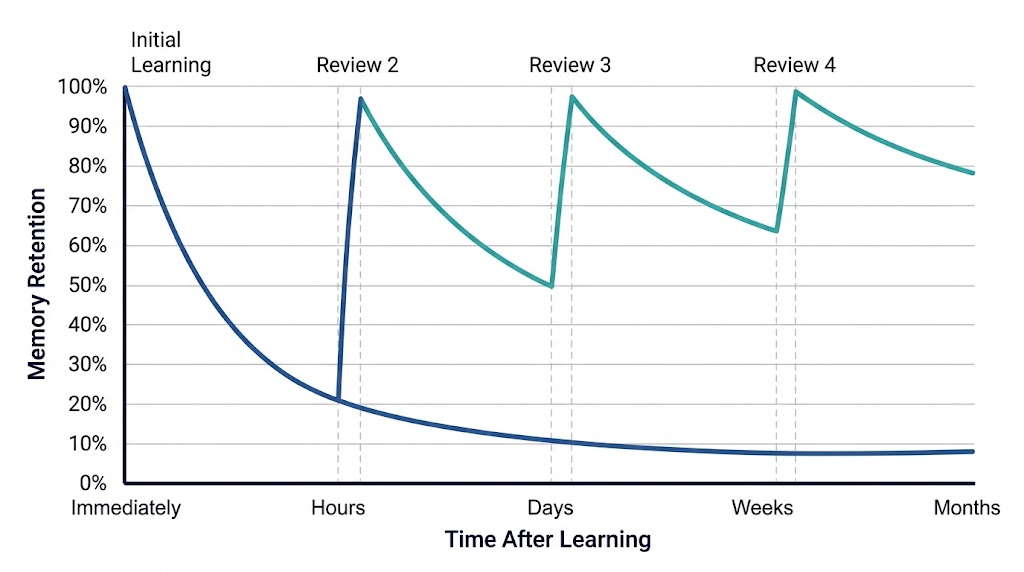
Your brain tries to save energy by clearing out details you do not use regularly. Spaced practice interrupts this forgetting process. Every time you pull a fact out of memory, you send a signal to your brain that the detail is useful.
Cognitive scientists call this active recall. Reading notes feels easy because recognition takes minimal mental effort. Answering a question on a flashcard requires your brain to work harder. That mental effort builds stronger neural connections.
"When you struggle to retrieve information, you send a strong signal to your brain to solidify that neural pathway."
How Honest Grading Supercharges Your Flashcards
Flashcards remain one of the most effective tools for active recall, but how you use them matters. When you use the free flashcard maker on classconnect, you get access to an interactive revise mode that changes how you review material.
When a card pops up, you attempt the answer first. Then you grade your own performance based on an honest reflection of your recall.
- Easy: You recalled the answer immediately with zero hesitation.
- Good: You got the answer right, but it took real effort to remember.
- Hard (Barely): You partially understood the answer.
- Again (Forgot it): You got the answer incorrect.
Honest self-assessment is the secret here. If you mark a hard card as easy just to feel good, the algorithm schedules it far in the future, and you forget it by exam day. But when you give accurate feedback, the system targets your exact weak points. It brings back hard questions frequently while pushing mastered concepts further out.
Why Cramming Fails and Spaced Practice Wins
Cramming creates short-term familiarity, not actual learning. You might pass a test the next morning, but two weeks later, the knowledge vanishes. That creates serious problems when subject material builds on prior knowledge, like in math, science, or languages.
- Cramming: High recognition and fast memory loss, with minimal retention after one week.
- Spaced revision: A steady build in understanding and high retention over months or years.
Spaced practice creates durable memory because it relies on memory consolidation. While you sleep between review sessions, your brain reorganizes and stores newly acquired facts. Spacing out your reviews gives your mind the time it needs to process concepts deeply.
You actually spend less total time studying when you use spaced revision. Spending fifteen minutes a day over a week yields far better results than studying for four straight hours the night before a test.
Simple Steps to Build a Daily Spaced Revision Routine
Starting a new study habit does not need to feel overwhelming. You can build a system that takes less than twenty minutes a day.
- Create your cards right away: Build new cards after lectures while the ideas remain fresh.
- Set a daily review time: Dedicate fifteen minutes every morning or evening to complete your pending card deck.
- Be real with your self-grading: Grade your responses truthfully so the system targets your exact needs.
- Keep sessions short: Stop reviewing once you finish your daily target to prevent mental fatigue.
Consistent daily practice builds momentum. You will notice tests feel less stressful because you arrive fully prepared without pulling late nights.
Take Control of Your Learning Today
Studying harder rarely produces results if your strategy works against how human brains function. Rereading chapters over and over creates a false sense of mastery, while spaced revision builds long-term knowledge through efficient active recall.
By combining spaced learning with an adaptive flashcard tool like classconnect, you take the guesswork out of test preparation. You spend time studying what you actually need to practice instead of repeating stuff you already mastered. Start building your cards today, stay honest with your grading, and watch your memory retention improve.